
Drain Excavation in Rainham
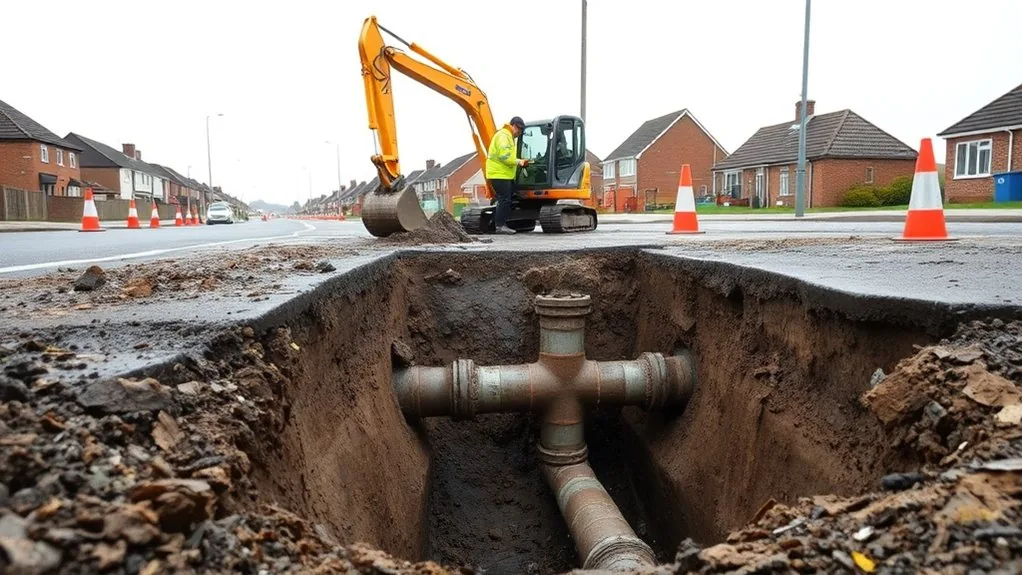
If jetting or relining cannot fix your damaged drains in Rainham, controlled excavation may be necessary to access and repair the affected pipes safely.
This process involves careful diagnostics and safety measures to protect your property and comply with regulations.
Contact us for a fast quote or emergency callout in Rainham.
When surface-level repairs just won’t solve the problem, drain excavation is the controlled process of digging down to expose damaged underground pipework so it can be repaired or replaced safely and correctly. You’re dealing with a targeted civil-engineering task, not casual digging, so it must follow strict safety and utility-location procedures.
In practice, you’ll see drain excavation used when long-term drain maintenance or lining isn’t structurally viable. Engineers assess pipe depth, loadings, access, and perform soil analysis to understand stability, groundwater, and contamination risks before breaking ground. Excavation then proceeds in stages, with shoring, barriers, and spoil management to protect people and property. Once the pipework’s renewed to specification, backfilling and compaction restore structural integrity and surface levels.
When you’re facing persistent drainage backups, recurrent blockages even after professional clearing, or visible ground subsidence, it’s a strong indication that your underground pipework may be structurally compromised and in need of excavation. You should also treat sewer odours and unexplained damp patches around your property as early warning signs of potential leaks or collapsed sections. By recognising these indicators promptly, you can commission a targeted drain survey and, where necessary, controlled excavation to safeguard your property and ensure system safety.
How do you know a recurring drain issue isn’t just a minor blockage but a structural failure that demands excavation? You look for persistent drainage backups that return quickly despite correct drain maintenance and safe use. When water repeatedly rises from low-level fixtures, gurgles through multiple outlets, or brings foul odours and silt, you’re likely facing collapsed or displaced pipework.
| Warning Pattern | What It Often Indicates |
|---|---|
| Backups after light use | Pipe deformity or partial collapse |
| Waste in lowest outlets | Major obstruction in main run |
| Slow drain, sudden surcharge | Root ingress or joint failure |
| Backups plus ground softening | Pipe leakage affecting soil stability |
At this stage, CCTV surveying and calculated excavation are the safest, long-term solutions.
Persistent backups are only part of the picture; recurrent blockages that return soon after being cleared are another strong indicator that the underlying pipework’s compromised and may need excavation. If your drains seem fine after rodding or jetting but clog again within days or weeks, you’re likely dealing with more than routine clogged pipes.
Repeated issues often point to structural defects: cracked sections, collapsed joints, severe root ingress, or displaced liners that trap debris and restrict flow. You might notice gurgling, slow drainage, or water pooling around inspection covers each time the problem returns.
At this stage, relying on repeated clearances isn’t safe or cost‑effective. A CCTV drain survey can confirm the fault’s location and depth, guiding targeted, controlled excavation.
Although it’s easy to dismiss at first, visible ground subsidence above or near your drainage line is a serious red flag that often warrants excavation. Depressions, sinking paving, or localized hollows in lawns typically indicate soil has been washed away by leaking pipes, undermining ground stability and, in severe cases, nearby structures.
You shouldn’t just fill these dips with topsoil. Until the defective drain is exposed and repaired, erosion will continue beneath the surface. A professional excavation allows technicians to locate collapsed sections, failed joints, or cracked pipes that CCTV alone can’t always confirm. By reinstating the pipework on a proper granular surround and compacted backfill, you restore support to the surface and deliver long‑term subsidence prevention around your Rainham property.
Ever noticed a lingering sewer smell indoors or patches of unexplained damp around floors, skirtings, or external walls? Persistent sewer odours often indicate fractured or displaced underground pipework, allowing foul air to escape and bypass water traps. At the same time, hidden leaks saturate surrounding soil and structures, leading to damp issues, mould growth, and potential damage to foundations and timber.
If standard CCTV surveys show broken or collapsed sections, no‑dig lining may not restore full structural integrity or stop contamination. In these cases, controlled drain excavation in Rainham becomes the safest option. By exposing the defective run, specialists can replace failed pipework, reinstate proper gradients, upgrade joints, and install reliable seals, eliminating sewer odours and preventing ongoing damp issues.
When drains in Rainham fail and excavation becomes necessary, it’s usually due to a predictable set of causes: ground movement and subsidence, root intrusion from nearby trees, age‑related pipe deterioration, incorrect falls or poor original installation, heavy vehicle loading over shallow lines, and recurring blockages from fats, oils, grease, and foreign objects. You’ll also find that older drain material, such as clay or pitch fibre, is far more prone to collapse, displacement, and cracking than modern PVC systems.
To understand why digging becomes unavoidable, consider:
When you call us for drain excavation in Rainham, we first carry out a precise diagnosis using CCTV inspection to pinpoint faults and assess the structural condition of your pipework. We then apply the safest and most effective clearance method for your system, from high-pressure jetting to rodding and mechanical clearance, ensuring controlled operation that protects surrounding services and ground stability. If we identify cracks, collapses, or severe corrosion, we’ll advise whether targeted repairs or trenchless relining can restore integrity while minimising excavation and disruption.
How do you pinpoint the exact cause of a drain problem before you start digging? You start with diagnosis. A full site assessment comes first: you’ll have pipe locations mapped, cover levels checked, and service drawings reviewed to avoid utilities and protect soil stabilization around the trench line.
Next, a CCTV inspection camera is fed through the drain to record high‑resolution video of cracks, collapses, root ingress, and joint failures. Live footage lets technicians measure defect locations to the millimetre, so excavation is limited to the shortest, safest section. This targeted approach reduces the environmental impact of digging, minimises waste removal, and lowers reinstatement requirements. Ultimately, you get a precise repair plan before a single spade breaks ground.
Ever wondered why serious drain excavations in Rainham nearly always start with high-pressure jetting rather than a digger? You’re protecting both your drains and your budget. Hydro jetting uses water at controlled, ultra-high pressure to strip away fat, silt, roots, and scale so you only excavate when absolutely necessary.
| Fear/Frustration | What High-Pressure Jetting Gives You |
|---|---|
| “My garden will be ruined.” | Targeted cleaning, minimal digging |
| “This will cost a fortune.” | Fewer excavations, controlled costs |
| “Will it even fix it?” | Clear lines, evidence-based decisions |
After your initial pipe inspection, jetting restores internal diameter and flow, revealing whether defects are just heavy deposits or true structural failures. You get a safer site, accurate excavation planning, and drains prepared for lasting repair.
High-pressure jetting isn’t always the only answer, especially in older or fragile pipework, so rodding and mechanical clearance come into play as controlled, low-impact options before excavation. You benefit from targeted drain cleaning that physically breaks up obstructions while minimising hydraulic shock to joints and seals.
Engineers select rigid or flexible rods, mechanical cutters, or rotary descaling heads based on CCTV survey findings, pipe material, and diameter. Torque, rotation speed, and feed rate are carefully controlled to avoid cracking vitrified clay or dislodging joints. Where roots or compacted scale are present, mechanical clearance can restore flow and allow accurate condition assessment.
On external systems, soil testing around the line helps confirm ground stability, ensuring that any invasive access points or follow-on excavation remain structurally safe.
Once cleaning and diagnostics have ruled out simple blockages, it becomes a structural problem, and that’s when repair, relining, or carefully planned drain excavation in Rainham is required. You’ll typically need drain repair if CCTV shows cracked, collapsed, or displaced sections, open joints, or serious root ingress compromising flow or stability.
Pipe relining is considered first because it’s no-dig, fast, and creates a structural “pipe within a pipe.” It’s ideal when the host pipe still holds its shape and access is safe. Where the line is deformed, back-falling, or leaking at junctions, targeted excavation allows sectional replacement, joint reconstruction, and installation of new access points. Throughout, safety barriers, utility checks, and confined-space protocols protect your property and everyone on site.
When a drain collapses or a sewer line fails, you can’t afford to wait, which is why our excavation teams are mobilised rapidly across Rainham. You get a structured response: initial phone triage, remote review of plans and CCTV footage where available, then deployment of an appropriately equipped crew.
Engineers arrive with confined-space gear, shoring equipment, and pumps, so excavation can begin safely and efficiently. We carry out on-site risk assessments, set exclusion zones, and implement strict safety precautions to protect you, your property, and our operatives.
Our rapid mobilisation also reduces flood damage, downtime, and environmental impact by limiting sewage escape to soil and watercourses. You’ll get a clear action plan, timescales, and communication at every stage.
Although every drainage issue looks similar on the surface, the legal responsibility for excavation depends on exactly where the defect sits in the network and how the pipe is classified. In Rainham, you’re normally responsible for private drains within your property boundary, up to the point where they connect to a shared or public sewer.
The water company typically maintains public sewers and lateral drains outside your boundary, while local authorities may be involved if highways or public land are affected. Before any work starts, you must confirm ownership through surveys, plans, or CCTV inspections.
Whoever is responsible must also guarantee excavation safety, compliance with permits, and correct reinstatement, integrating the work with ongoing drain maintenance obligations.
Even after a successful excavation and repair, drains in Rainham stay trouble‑free only if you treat the system as critical infrastructure rather than an invisible convenience. You need a simple, disciplined maintenance strategy that prevents small defects turning into another disruptive dig.
Because drain failures are rarely simple, you need a contractor that combines structural diagnostics, safe excavation practices, and compliant reinstatement — not just a team with a digger. You get engineers who start with detailed CCTV pipe inspection and tracing, so excavation is precisely located and disruption is kept to a minimum.
We risk-assess every site, protect utilities and structures, and use shoring, barriers, and confined-space protocols to keep your property and people safe. Our teams understand Rainham’s varied ground conditions, highway requirements, and local authority standards, so reinstatement meets regulatory expectations.
You also benefit from integrated drain maintenance planning once the repair’s complete, reducing repeat failures. From collapsed sewers to root-damaged laterals, we give you a documented, engineered solution, not a temporary fix.
You’ll naturally want clear answers on how fast we can attend, what drain excavation in Rainham is likely to cost, and whether it’s safe to attempt any initial steps yourself. We’ll address these points with practical, technically accurate guidance so you can make informed, risk-aware decisions. You’ll also see exactly which areas of Rainham we cover, so you know you’re within reach of a prompt, compliant solution.
While rapid response is often critical with a failing drain, the speed at which we can carry out drain excavation in Rainham depends on how quickly we can diagnose the fault, obtain permissions (where needed), and confirm the site is safe to dig. In many emergencies, we’ll attend the same day, complete CCTV surveys, and stabilise the system while planning excavation.
If access is straightforward and utilities are clearly mapped, excavation can often start within 24–72 hours. Complex sites, highways, or shared systems can take longer due to permits and coordination with local authorities.
Good drain maintenance usually shortens timescales because we already understand your system layout. Throughout, we prioritise excavation safety, structural integrity, and minimising disruption to your property and neighbours.
Several key factors determine the cost of drain excavation in Rainham, and it’s important to understand these before any work starts. You’ll typically be quoted based on excavation depth, pipe diameter, length of affected run, soil type, and how close the drains are to buildings, utilities, or highways.
Costs increase if specialist shoring, traffic management, or utility tracing is required to keep the site safe and compliant. Access is critical: tight spaces, concrete surfaces, or complex landscaping all add labour and reinstatement costs.
You should also factor in CCTV surveys, replacement pipework, backfilling, and surface reinstatement. Investing in post-repair drain maintenance helps protect your budget long-term by stabilising water flow, reducing the risk of repeat excavation and associated disruption.
Often the first question is whether you can safely tackle a suspected drain problem yourself before calling in excavation specialists. In many cases, you can try simple, low‑risk measures first. Suitable DIY tips include using a plunger, enzyme‑based cleaners, or lifting accessible inspection covers to check for obvious blockages—provided you know what you’re looking at.
However, you must follow strict safety precautions. Don’t enter chambers, don’t use aggressive chemicals, and never dig near foundations, utilities, or public sewers without proper plans and permits. If you notice repeated blockages, foul smells, visible ground subsidence, or wastewater backing up indoors, it’s no longer a DIY issue. At that point, you’ll need a professional survey to determine whether excavation is required.
Wondering if your part of Rainham’s included in our drain excavation service area is completely understandable, especially when you need a rapid, safe solution. We cover most of Rainham, including urban, suburban, and rural sites, provided we can access the drains safely and comply with local regulations.
Because excavation’s intrusive, we always confirm access, traffic constraints, and underground service maps before booking. Where excavation permits are required, we’ll handle the paperwork and method statements, so the job progresses without legal or safety delays.
| Area Type | Typical Locations | Key Consideration |
|---|---|---|
| Urban | Canterbury, Maidstone, Ashford | Traffic management |
| Suburban | Tonbridge, Sevenoaks, Sittingbourne | Neighbour/property safeguards |
| Rural | Villages and farms across wider Rainham | Access and ground conditions |
Contact us to confirm coverage for your postcode.
Yes, drain excavation can affect your home insurance and premiums. You must inform your insurer before starting the work and provide relevant documents such as CCTV survey reports, method statements, and contractor details. If the excavation lowers risks like flooding or subsidence, your premiums may remain the same or decrease, but unreported structural changes could affect your cover or increase costs at renewal.
Excavation work can continue during heavy rain or winter conditions only if it is safe and properly controlled. Heavy rain often causes delays due to saturated ground increasing the risk of collapse and contamination. In winter, frozen soil, poor visibility, and manual handling hazards present additional challenges that require careful management.
The drain excavation process is moderately noisy and temporarily disruptive for neighbours. They will hear machinery, feel vibrations, and notice disruptions to access and parking. Noise mainly comes from breakers, pumps, and spoil removal, which usually occur during regulated working hours.
You usually do not need full planning permission for drain excavation on your property. However, if the drain is shared or near the highway, you will likely need excavation permits and written consent from your local authority or water company. You must also comply with Building Regulations, protect existing services, and prepare method statements and risk assessments to ensure the work is safe and compliant.
After drain excavation work, written warranties are provided on materials, workmanship, and drain longevity when approved excavation techniques are used. These warranties typically cover pipe joints, surface reinstatement, and structural integrity, and should be backed by insurance. CCTV evidence before and after the work, along with a maintenance schedule, is usually provided to keep the warranty valid.
When a drain fault escalates beyond simple jetting or rodding, getting your drain excavation sorted quickly—and correctly—is critical to protecting your property and maintaining compliance with local regulations in Rainham. You need a structured approach: CCTV diagnostics, utility tracing, and a method statement that covers shoring, access, and reinstatement.
A competent team will isolate the fault, calculate safe excavation depths, and select suitable pipe materials and bedding, ensuring long‑term drain maintenance rather than a short‑term patch. Throughout, they’ll manage spoil, groundwater, and backfill to minimise environmental impact and prevent contamination of nearby watercourses or habitats.